The complete cover letter guide: what to include, what to cut, and templates that convert
Jorge Sánchez·August 24, 2026
Cover letters are read for 30 seconds or not at all. Here's the structure that survives the scan, per-role templates that don't sound generated, and the openings that earn the second paragraph.
Cover letters got a bad reputation for one reason: 90% of them are the same template with the company name search-and-replaced in. Recruiters spot them in the first sentence and stop reading. But the remaining 10% — the ones written like a real note to a specific person — measurably lift interview rate, especially at companies where the hiring manager reviews applications before HR.
Skip the template hunt — Emplirao's cover letter templates are matched to resume templates, share the same visual voice, and export to ATS-parseable PDF alongside your CV.
Browse cover letter templatesWhen a cover letter actually matters
- Small companies and startups: the hiring manager usually reads the letter. Skipping it signals "applied to 40 places today."
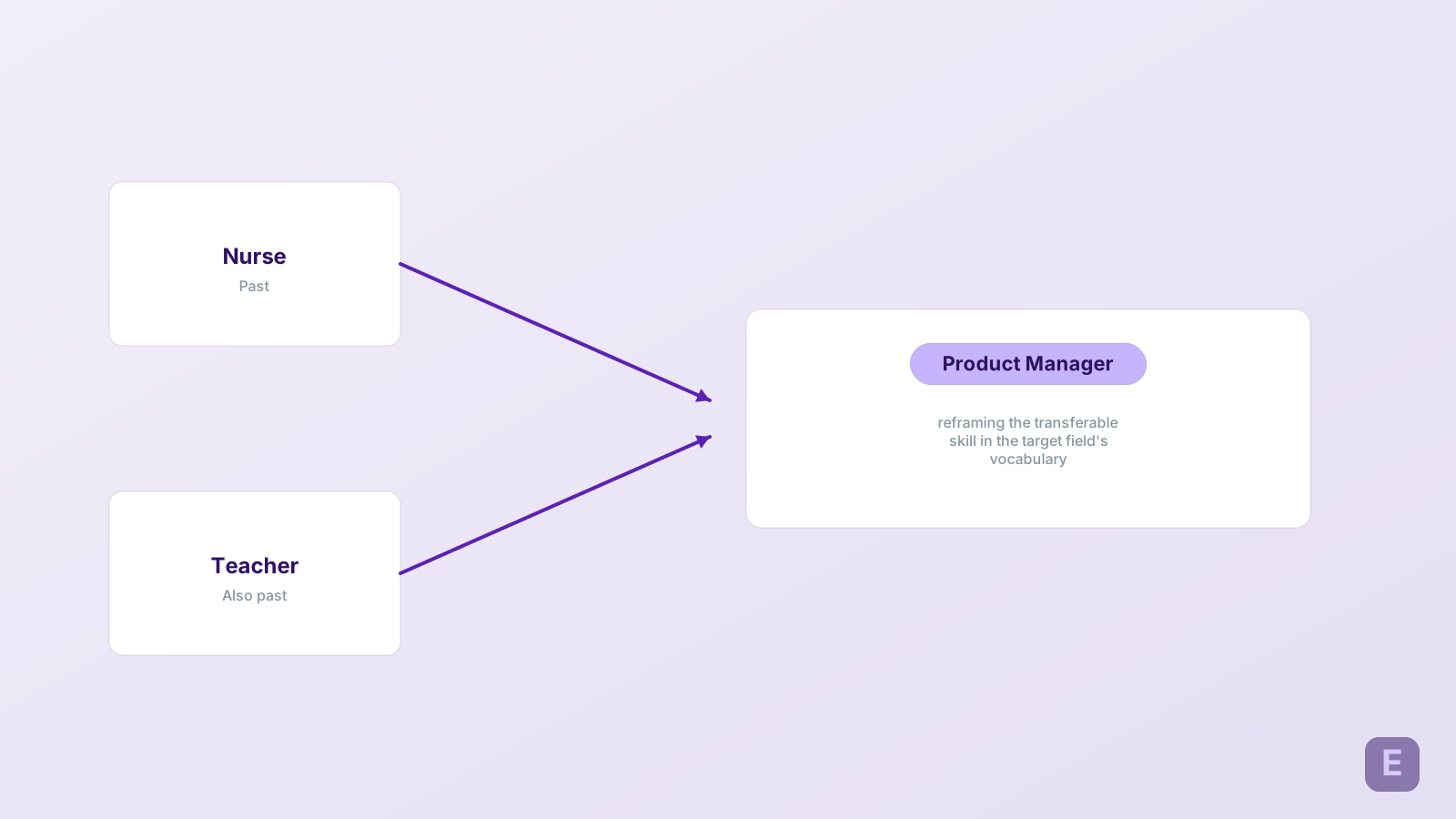
- Career-change roles: the letter is the only place to explain the pivot before the recruiter scans experience.
- Public-sector, academic, NGO, and legal roles: often required and read cover-to-cover.
- When the JD explicitly says one is optional: send one. "Optional" reads as "tiebreaker."
For large-tech job applications routed through Workday-style portals with hundreds of applicants per role, cover letters are frequently skipped by both automated screening and the first human pass. Time spent on a tightly-tailored resume is a better bet in that context.
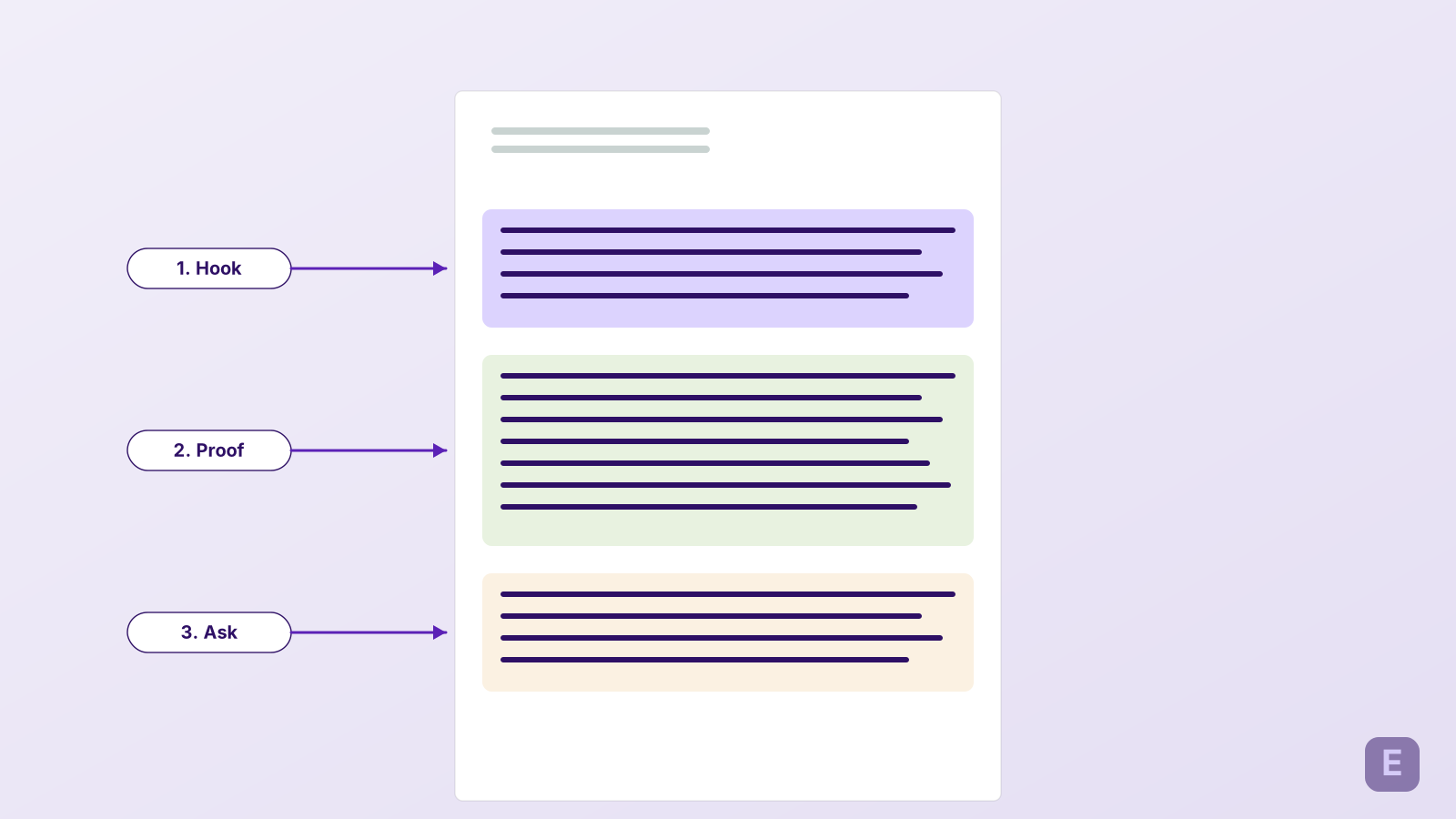
The three-paragraph structure that works
Paragraph 1 — the hook (30-50 words)
One specific reason you're applying to THIS company, this week, for this role. Not "I've long admired…" — a fact. A shipped product you use, a public post from the team, a public metric they hit, an alumni connection. If you can't name a specific reason, the letter isn't ready yet.
Paragraph 2 — the proof (60-90 words)
ONE story from your CV that maps to the top requirement of the JD. Not a summary of everything you've done — one project, one outcome, one paragraph. Include a number if you have one. Reference a specific technology, methodology, or client that mirrors the JD's language.
Paragraph 3 — the ask (25-40 words)
One sentence. "I'd like a 20-minute conversation about how I'd approach [specific problem from the JD] in the first 90 days." No "looking forward to hearing back," no "thank you for your time." A specific ask.
The one thing to change per application
Structure stays fixed. Only paragraph 1 (the hook) and one sentence of paragraph 2 (the proof to match the JD) change per application. This is the whole reason cover letters are efficient — a 200-word note takes 5 minutes to adapt from a template you've written once.
What stays fixed vs what changes per application
| Element | Fixed / changes | Time per app |
|---|---|---|
| Contact block | Fixed | 0 min |
| Recipient (name + company) | Changes | 1 min |
| Hook paragraph | Rewrites | 2 min |
| Proof paragraph | One sentence swaps | 1 min |
| Ask sentence | JD-specific verb | 1 min |
Emplirao's AI cover letter feature drafts the hook and proof paragraphs from your CV + any job description you paste — you edit for voice, not from scratch.
Draft a cover letterOr paste any job description into the free AI generator to draft the opener and first proof paragraph in ~10 seconds — no signup.
Try the AI cover letter generatorOpeners and closers that survive the scan
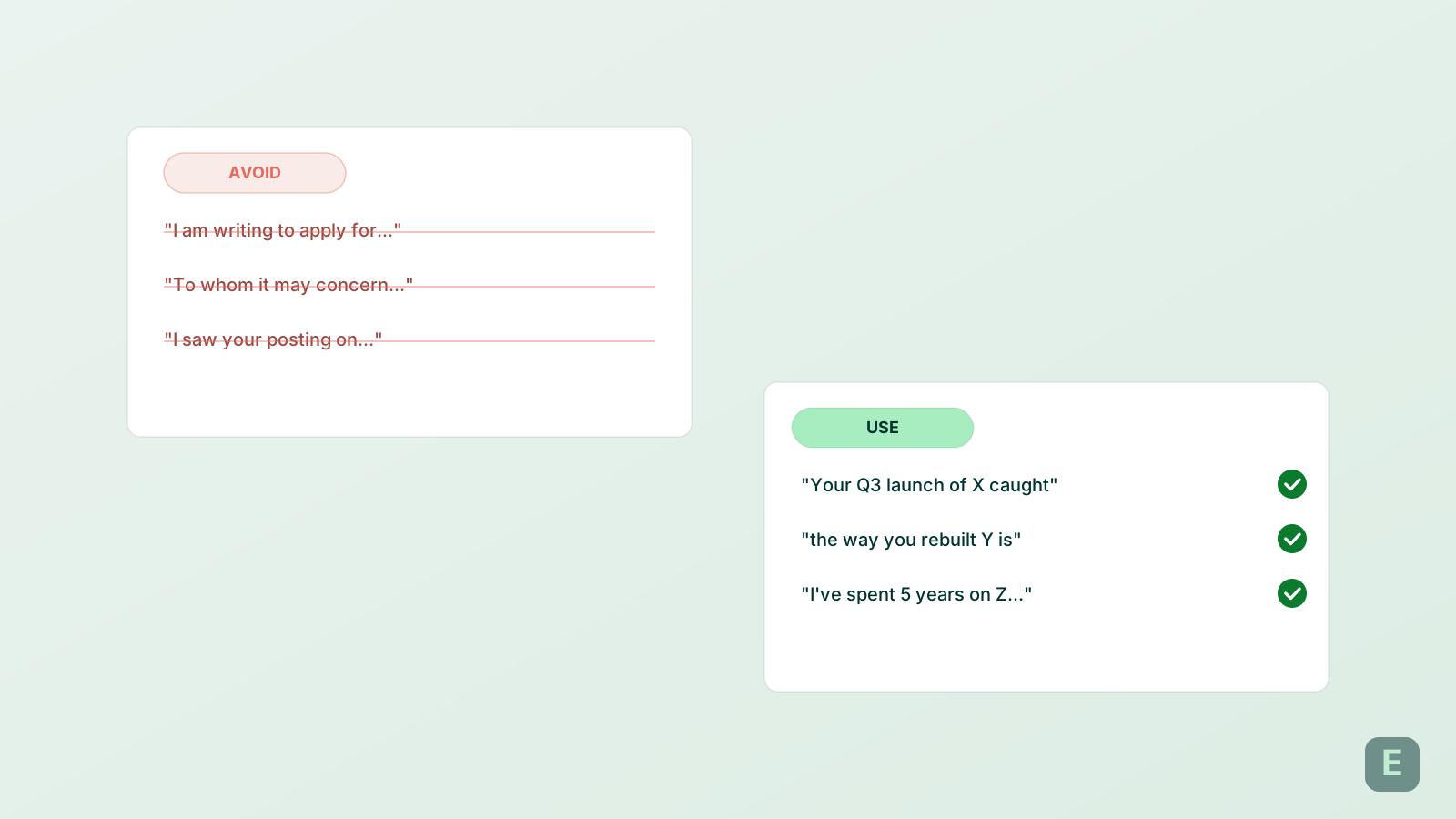
- Opener that works: "Your recent launch of [product] hit a problem I've spent the last two years solving at [company]."
- Opener that works: "I noticed your engineering team open-sourced [library] last month. The design decision to [thing] is exactly what I built at [prior role]."
- Closer that works: "I'd like a 20-minute conversation about how I'd approach [problem from JD] in the first 90 days. Available any morning next week."
- Never open with: "I am writing to apply for the [role] position."
- Never open with: "I came across your job posting and…"
- Never open with: "With over N years of experience in…"
- Never close with: "I look forward to hearing from you."
Length, format, and file
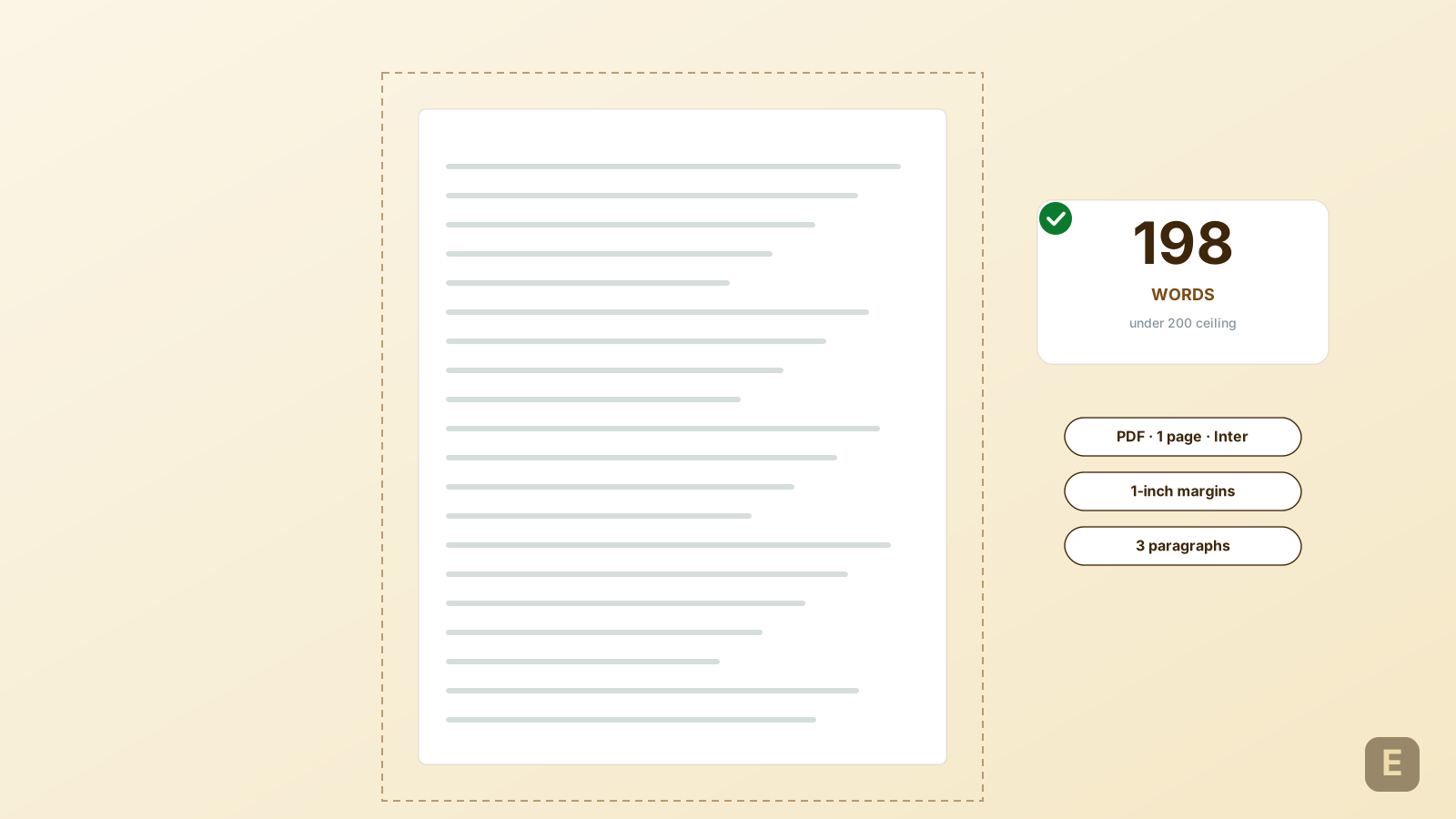
- Under 200 words total. Recruiters give 20-30 seconds of scan time; longer letters get skimmed instead of read.
- PDF, same font as your resume. If your resume is Inter, your cover letter is Inter.
- One page. Never two. If it's spilling to two pages, the proof paragraph is telling too many stories — cut to one.
- File name: FirstName-LastName-CoverLetter-Company.pdf.
Frequently asked questions
- Do employers still read cover letters?
- It depends on the company shape. Small companies and startups: yes, usually cover-to-cover. Mid-size (100-1,000): the hiring manager reads them for shortlisted candidates. Big-tech and Workday-portal roles at 1,000+ applicants: often skipped. Public-sector, academia, NGO, and legal: always read.
- Should I use ChatGPT to write my cover letter?
- As a first draft, yes — but only when it's grounded in your actual CV and the actual job description. Blank-prompt output ("write a cover letter for a marketing role") produces recognizable AI phrasing that recruiters now filter for. Emplirao's cover letter drafter uses your parsed CV + the JD, then lets you edit for voice.
- What about addressing "Dear Hiring Manager" vs a specific name?
- A named person is worth 30 seconds of LinkedIn search. If the JD names a hiring manager, use them. If not, search "[company] [role] recruiter" on LinkedIn — the name that appears is usually the person handling the pipeline. If nothing surfaces, "Dear [Team name] Hiring Team" beats generic "Dear Hiring Manager" every time.